Growing Up Beside a Bright Public Light
I keep thinking about how some lives unfold like fireworks, loud, fast, impossible to miss, while others move like candlelight across a dark room. Daylen Ali Carolina seems to belong to the second kind. His name may appear beside a famous family, but his own story is shaped less by spectacle and more by restraint. That contrast is what makes him interesting to me.
Being the child of a well known mother does not automatically turn a person into a public character. It can do the opposite. It can teach caution early. It can create a sharp awareness of where the camera ends and the self begins. In Daylen Ali Carolina’s case, that boundary seems to have held steady for years. He exists in the public imagination mainly through family connections, yet his own footprint remains light. That is not emptiness. It is design.
There is something almost architectural about that kind of life. The public sees the facade, the family name, the occasional mention, but the private structure is the important part. The rooms inside are not for display. They are for growing, changing, arguing, laughing, and becoming. I find that more compelling than a flood of oversharing.
A Family Story Built from Different Creative Worlds
The family around Daylen Ali Carolina has its own layered rhythm. His mother, Terri J. Vaughn, built a career that placed her in homes, on screens, and in the memories of viewers. His father, Derrick A. Carolina, brings a different creative current through music publishing and composition. Those two paths already suggest a household shaped by expression, discipline, and the constant work of turning feeling into form.
That mix matters. In many families, creativity is treated like a hobby. In others, it is the weather. It affects the whole atmosphere. A child growing up in that kind of environment can absorb more than career advice. He can absorb ways of listening, ways of noticing, ways of reading a room. He learns that talent is not only performance. It is also patience, editing, timing, and knowing when to speak and when to stay quiet.
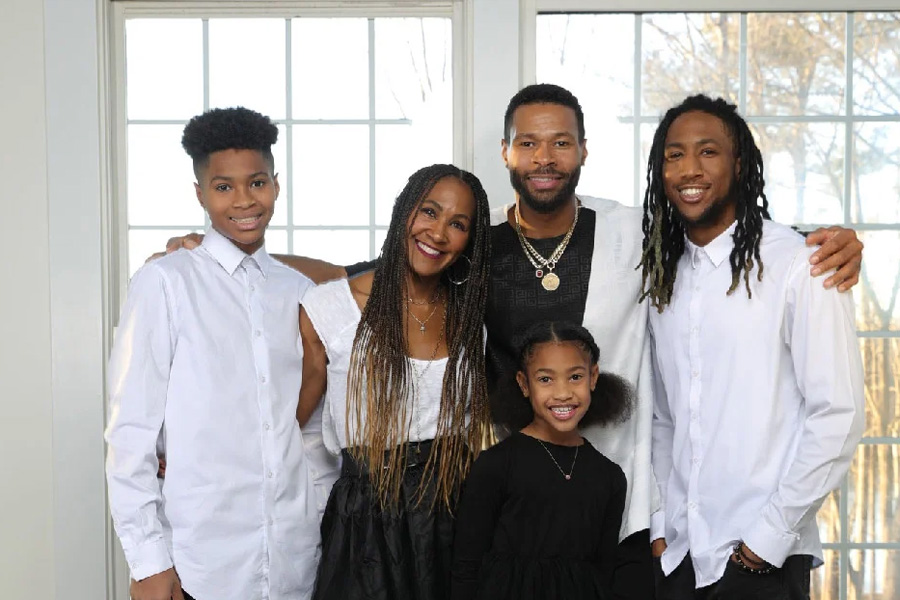
Then there is the expanded family circle. Terri’s marriage to Karon Riley added another branch to the tree, along with two younger half siblings. That changes the texture of any household. The eldest child often becomes a witness to the family before it fully remakes itself. He remembers the earlier version. He sees the transition. He learns that family is not frozen in one shape. It keeps shifting like a shoreline.
That is one of the most human parts of Daylen Ali Carolina’s story. He is not defined by a single clean line. He is part of a blended family, and blended families are living mosaics. They gather new pieces over time. They do not apologize for that. They simply become larger, more complex, and often more resilient.
The Value of Staying Low Profile
I admire the discipline required to keep a low profile when the culture rewards visibility. We live in a time when attention is treated like proof of existence. Post often enough and people assume you are real. Stay quiet and they assume you are absent. But Daylen Ali Carolina seems to challenge that logic.
Privacy is not a lack of confidence. Sometimes it is a form of strength. Sometimes it is the refusal to turn a personal life into a public product. That matters even more for children of celebrities, because the spotlight can arrive before identity has fully settled. It can flatten people into labels before they have a chance to choose their own outlines.
What interests me most is that a quiet profile can still carry meaning. A person does not have to be endlessly documented to matter. In fact, a life with fewer public markers can leave more room for actual growth. School years can remain school years. Friendships can stay friendships. Milestones can belong to the family rather than the feed. That is a very different kind of wealth.
Daylen Ali Carolina’s public silence also creates a kind of mystery, though not the cheap kind. Not gossip. Not bait. The better kind. The kind that makes you think about what a person protects and why. The kind that reminds me that dignity often lives in the spaces where no one is performing.
Family Fame and the Weight of Expectations
There is a special pressure that comes with being related to someone famous. The last name opens doors, but it can also cast a long shadow. People compare, assume, project, and speculate. They may expect a son to echo his mother, or a daughter to repeat the parent’s charisma. But children are not photocopies. They are separate weather systems.
Daylen Ali Carolina seems to stand at that intersection, where the family name is recognizable but the personal path is not publicly staged. That in itself says something. It suggests that he may value authorship over inheritance. Not every person born near fame wants to inherit the spotlight. Some prefer to inherit the right to choose.
That choice can be harder than it looks. A public family can make silence feel unusual. Relatives might appear in photos, celebrations, and brief mentions, yet none of that has to become a career story. The line between family memory and public biography can stay firm. I respect that line. It is one of the few forms of control a private person can keep in an attention economy.
I also think that his family structure offers a useful model of modern belonging. The older child, the younger siblings, the stepfather, the parents, the extended kin, all of them form a network rather than a single thread. That network matters because identity is often built by repetition. The same names, the same holidays, the same stories told in new ways. Over time, those small repetitions become a person’s inner furniture.
What His Story Suggests About Identity Today
I see Daylen Ali Carolina as part of a larger cultural pattern. More and more, children of public figures are choosing lives that are less legible to strangers. They are not always chasing fame. They are sometimes escaping its gravity. That shift tells me that identity today is becoming more negotiated, more selective, and in some cases more protected.
I think that is healthy. A person should not have to become content simply because their family is content to the world. They should be allowed to remain ordinary where they wish, and extraordinary only where they choose. The ordinary is not small. It is the soil where most real lives grow.
When I look at Daylen Ali Carolina through that lens, I do not see a missing biography. I see an unfinished one, and unfinished is not a flaw. It is a condition of being alive. People are not meant to be fully explained at once. Some stories are meant to unfold like a slow song, verse by verse.
FAQ
Who is Daylen Ali Carolina?
Daylen Ali Carolina is the son of Terri J. Vaughn and Derrick A. Carolina. He is known mainly for keeping a very private life rather than for any public career.
Why is Daylen Ali Carolina mentioned online so often?
He appears in discussions about his family, especially because of his mother’s public profile. That does not mean he is a public figure himself. It mostly means people are curious about the private side of a recognizable family.
Does Daylen Ali Carolina have siblings?
Yes. He has two younger half siblings, Kal’El Joseph Riley and Lola Riley. Their presence adds a second rhythm to the family story, one that is more blended and expansive.
Is Daylen Ali Carolina active in entertainment?
There is no widely known public entertainment career attached to his name. His life seems to stay outside the marquee, which is part of what makes him different from many children of celebrities.
What makes his story interesting?
What interests me is the contrast. He is connected to a family with public visibility, yet he appears to choose privacy. That tension between exposure and restraint gives his story a quiet force.
What can be learned from Daylen Ali Carolina’s approach to privacy?
I think his example suggests that privacy can be intentional, not accidental. A person can value family, stay near public life, and still refuse to become a public brand. That choice can protect identity, preserve space, and keep life from being swallowed by attention.